Skip to content
Patient Intelligence System

Your patient has twenty years of records. Caredevo reads all of it before you walk in.

Caredevo Patient Intelligence is not an AI scribe. It is a multi-agent system that analyses the full patient record — prescriptions, medical history, blood tests, letters, investigations, and preventive care — and surfaces what matters before and during every consultation.

Twelve specialised agents work in parallel: Pre-Consult, Prescription, Patient Journey, Preventive Care, Blood Test Trend, Letter Summary, Investigation List, Referral Tracker, Sorting, Team Management, Consultation Query, and Post-Consult. One intelligence layer across your entire patient database.

No credit card required

Caredevo Patient Intelligence — GP consulting with patient supported by twelve AI agents

Beyond AI scribe

Not just this consultation. The whole patient picture.

AI scribes capture one session. Caredevo analyses the full longitudinal record.

Multi-agent intelligence

Seven specialised agents running in parallel.

Each agent focused on a different dimension of the patient record.

Live during consultation

Query any record in real time without breaking workflow.

Ask Caredevo a question mid-consult. Get the answer instantly.

The problem with one consult at a time

The patient has been coming for twelve years. You have fifteen minutes.

Robert is 68. He has IHD, post-PCI from 2019, type 2 diabetes, CKD stage 3, hypertension, and gout. He takes eleven medications. His last cardiology letter was eight months ago. His HbA1c has been creeping up for two years. His eGFR has dropped three points since June. His bowel screening is overdue. His metformin dose was halved six months ago and no one followed up.

None of this is surfaced automatically. The GP opens the record and starts reading. The consultation clock is already running.

Caredevo Patient Intelligence changes this. Before Robert walks in, every agent has already analysed his record and prepared a structured briefing — scripts due, trends flagged, care gaps identified, journey summarised.

What Caredevo would surface for Robert before the consultation

  • Metformin halved 6 months ago — no follow-up HbA1c documented
  • HbA1c trending up: 6.8 → 7.1 → 7.4 over 24 months
  • eGFR dropped from 52 to 49 — CKD progression flag
  • Statin script due in 3 weeks — last dispensed 89 days ago
  • Cardiology letter (8 months): echo normal, continue current management
  • Bowel cancer screening 14 months overdue
  • Post-PCI sub-history: stent to LAD, dual antiplatelet until 2020, now aspirin only
  • Gout flare documented 4 months ago — allopurinol not yet commenced

All of this was in the record. None of it was visible at a glance. Caredevo makes it visible — before the consultation begins.

The intelligence layer

Twelve agents. Each one focused. All working from the same patient record.

Each agent specialises in one dimension of the patient record. Together they produce a complete pre-consultation intelligence briefing and a live query layer during the consultation.

Deploys a voice-based AI agent to take a structured patient history before the consultation begins — collecting presenting complaints, symptom duration, severity, mood, and any changes since the last visit — and writing the structured intake directly into the patient record.

What it analyses

  • Voice agent contacts the patient via phone or app before the appointment
  • Collects presenting complaint, symptom onset, duration, severity, and relevant changes
  • Asks condition-specific intake questions — pain scale, mood rating, breathlessness, swelling
  • Structures responses and writes them to the patient record for GP review before the consult

Output

A structured pre-consult intake note — presenting complaint, symptom summary, and patient-reported changes — available for the GP before the patient walks in.

Monitors medication history, flags scripts due for renewal, tracks dose changes, and identifies gaps or interactions across the full prescription record.

What it analyses

  • Identify medications due for repeat script based on supply and dosing
  • Flag recent dose changes and new medications added since last review
  • Detect potential interactions or omissions across the active medication list
  • Summarise medication timeline — what changed, when, and why

Output

Structured prescription summary with script-due alerts, change log, and interaction flags — ready for review at the start of every consult.

Builds a structured longitudinal narrative from the patient's full medical history, mapping sub-histories such as IHD, post-CABG, and post-PCI into a readable clinical timeline.

What it analyses

  • Synthesise full medical history into a structured narrative by condition and event
  • Map sub-histories — IHD, post-CABG, post-PCI, stroke, DM complications, and others
  • Surface the most relevant clinical context for the current consultation
  • Identify unresolved or ongoing issues from previous consultations and letters

Output

A structured patient journey summary — medical history, key events, and sub-histories — presented at the start of the consult so the GP starts fully briefed.

Analyses the patient's preventive care record, identifies what is overdue or approaching due date, and generates targeted recommendations for the current consultation.

What it analyses

  • Identify overdue cancer screening — bowel, breast, cervical, skin
  • Flag immunisation gaps — influenza, pneumococcal, shingles, COVID booster
  • Cardiovascular risk review due date — lipids, BP, smoking, waist circumference
  • Diabetic surveillance — HbA1c cycle, foot check, eye review, renal function

Output

A prioritised preventive care action list — what is overdue, what is approaching, and what should be addressed in the current consultation.

Creates structured trend analyses for key blood test parameters, showing direction of change, last result, and whether values are moving toward or away from clinical targets.

What it analyses

  • Trend HbA1c over 12–24 months with reference to target and direction of change
  • Track eGFR trajectory — identify early CKD progression
  • Trend LDL, total cholesterol, HDL, and triglycerides against cardiovascular targets
  • Summarise haemoglobin, ferritin, TSH, and other key parameters with last result and trend

Output

A structured blood test trend report — last result, prior results, trend direction, and clinical significance — for any parameter across the patient's pathology history.

Summarises all specialist letters, discharge summaries, and external correspondence in the patient's record — extracting key clinical findings, recommendations, and follow-up actions.

What it analyses

  • Extract key findings, recommendations, and diagnoses from specialist letters
  • Summarise discharge summaries — reason for admission, procedures, medications on discharge
  • Identify follow-up actions recommended by specialists that remain outstanding
  • Flag letters that have not yet resulted in a GP action or review

Output

A structured letter summary report — each correspondent, key findings, recommendations, and outstanding follow-up actions — available before or during the consultation.

Maintains a structured master list of all special investigations and blood tests performed — date, result summary, and clinical context — so nothing is lost in the record.

What it analyses

  • List all blood tests with date, result, and clinical context
  • List special investigations — ECG, spirometry, echo, stress test, CT, MRI, colonoscopy
  • Identify investigations ordered but not yet resulted
  • Flag investigations that are overdue for repeat based on clinical guidelines

Output

A complete structured investigation log — what has been done, when, what the result was, and what is pending or overdue.

Tracks every referral sent from the practice — who it went to, when, whether the specialist appointment was made, whether a letter came back, and which referrals remain pending or unanswered.

What it analyses

  • List all referrals sent with date, specialist, and reason for referral
  • Identify referrals where no reply letter has been received within expected timeframe
  • Flag referrals where the patient has not attended the appointment
  • Surface specialist recommendations from returned letters that have not yet been actioned

Output

A structured referral status report — sent, acknowledged, letter received, action taken — so no referral falls through the gap between the GP and the specialist.

Continuously processes all incoming documents — test results, specialist letters, scanned forms, imaging reports, and discharge summaries — analysing and summarising each one, then connecting it to the relevant diagnosis or clinical issue in the patient record.

What it analyses

  • Classify incoming documents by type: pathology, imaging, specialist letter, scanned form, discharge summary
  • Summarise each document — key findings, recommendations, and required actions
  • Link each document to the relevant active diagnosis or clinical problem in the patient record
  • Flag documents requiring urgent GP review or follow-up action

Output

A structured inbox — every incoming document classified, summarised, and connected to the relevant clinical issue — so nothing is filed without being understood.

Builds a structured view of every clinician and service involved in the patient's care — showing who has been responsible, what each person has done, and what tests, letters, blood tests, or procedures were performed or ordered by each member of the team.

What it analyses

  • List all clinicians involved — GPs, specialists, allied health, hospital teams — with dates of involvement
  • Attribute investigations, blood tests, and procedures to the ordering or performing clinician
  • Surface all letters and correspondence associated with each team member
  • Identify gaps in team communication — referrals sent but no reply, handover not documented

Output

A structured team and attribution report — who is involved, what each person has contributed, and where coordination gaps exist — giving the GP a complete picture of the care network around this patient.

Answers real-time clinical queries during consultation — surfacing relevant letters, test results, blood tests, active diagnoses, or previous diagnoses on demand.

What it analyses

  • Query: 'Show me the last cardiology letter' → retrieve and summarise
  • Query: 'What was the last HbA1c?' → surface result, date, and trend
  • Query: 'Has this patient had a colonoscopy?' → retrieve date, result, and recommendation
  • Query: 'List active diagnoses' → structured problem list with onset and status

Output

Instant retrieval of relevant clinical records in response to natural language queries — without interrupting the consultation workflow.

Runs on a set interval after the consultation — deploying condition-specific AI check-ins that ask the patient targeted follow-up questions, monitor symptoms over time, and escalate to the GP when responses are concerning.

What it analyses

  • Heart failure: weekly weight, breathlessness scale, ankle swelling, fatigue rating
  • Depression: weekly mood score, sleep quality, motivation, thoughts of self-harm
  • Diabetes: fortnightly HbA1c adherence, hypo episodes, dietary changes, foot symptoms
  • Escalate to GP immediately if responses cross clinical thresholds — weight gain >2kg in 2 days, PHQ-9 spike, reported hypo

Output

A structured longitudinal symptom monitoring log — patient responses at each interval, trend over time, and any escalation events flagged for GP review — written back to the patient SQL record.

Why seven agents

Each dimension of the patient record requires different analysis logic. A single agent would compress and miss. Seven focused agents produce richer, more accurate intelligence.

What this gives the GP

A complete structured briefing before every consultation — and a live query layer during it. The record speaks before the patient arrives.

How it connects to care plans

The intelligence layer feeds directly into care plan generation — GPCCMP, MHCP, Health Assessment — so every plan is grounded in the full patient picture.

How it works

From database to consultation-ready intelligence in four steps

Caredevo Patient Intelligence connects to the patient record, runs multi-agent analysis, and surfaces a complete structured briefing — before the consultation begins.

01

Connect to patient record

Caredevo connects to the local SQL patient database — medical history, pathology, medications, letters, investigations — building a full longitudinal picture.

02

Twelve agents run in parallel

Pre-Consult, Prescription, Patient Journey, Preventive Care, Blood Test Trend, Letter Summary, Investigation List, Referral Tracker, Sorting, Team Management, Consultation Query, and Post-Consult.

03

Pre-consultation briefing

Before the patient arrives, Caredevo surfaces a complete structured briefing — scripts due, care gaps, outstanding letters, blood test trends, patient history intake, and patient journey summary.

04

Live query and care plan generation

During the consult, query any record in real time, generate care plans and referrals from the consultation — then deploy the Post-Consult Agent for scheduled follow-up after the visit.

Caredevo Patient Intelligence workflow

Before the consult. During the consult. After the consult.

Connected to your local SQL patient database — Caredevo works across the full patient care cycle, not just the fifteen minutes in the room.

Before consultation

Pre-Consult Voice Agent

Patient answers structured history questions via voice before arriving.

SQL database analysis

All analysis agents run across the full patient record automatically.

Pre-consultation briefing

Scripts due, trends, care gaps, and patient journey ready before the patient walks in.

Document sorting and linking

All incoming results and letters classified and connected to diagnoses.

Central intelligence hub

Local SQL Patient Database

All twelve agents read from and write back to the same local SQL database — creating a continuous intelligence loop across every patient encounter.

Read → Analyse → Act → Write back
Intelligence layer

Twelve AI Agents

Pre-Consult
Prescription
Patient Journey
Preventive Care
Blood Trends
Letter Summary
Investigations
Referral Tracker
Sorting
Team Mgmt
Live Query
Post-Consult
During & after consultation

AI scribe

Record, dictate, Smart Paste, or type the consultation note.

Live clinical query

Ask any question about the patient record mid-consult — letters, results, diagnoses.

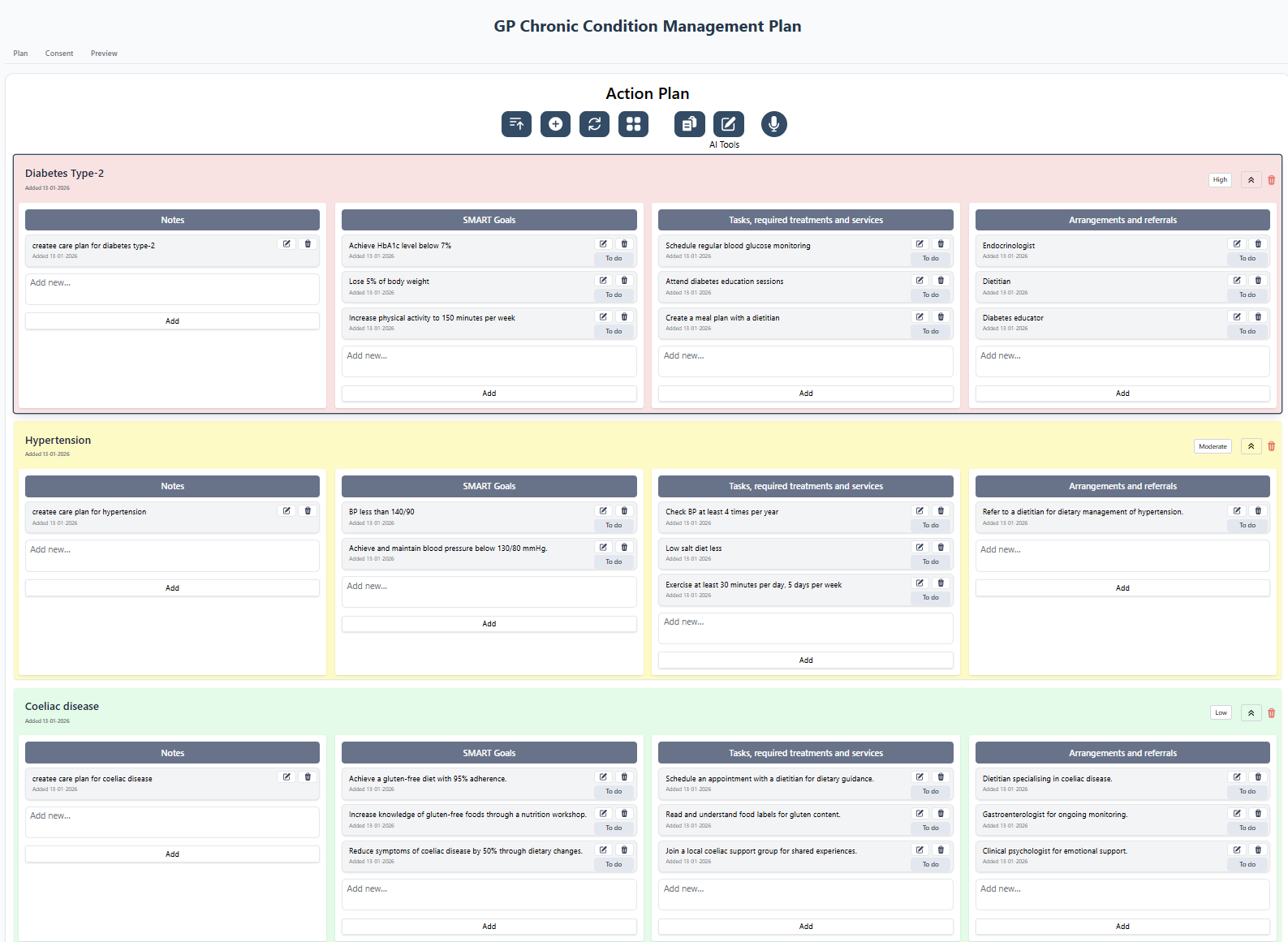
Care plan generation

GPCCMP, MHCP, Health Assessment and referrals generated from one consultation.

Team and referral view

See who is involved, what has been done, and which referrals are outstanding.

Post-Consult Agent deployed

Scheduled AI check-ins activated — condition-specific intervals set at consult.

Symptom monitoring intervals

Heart failure weekly, depression weekly, diabetes fortnightly — all automated.

Escalation to GP

Concerning responses flagged immediately — weight gain, mood spike, hypo event.

Record updated

All patient responses written back to the local SQL database for the next consultation.

Why local SQL matters

A local SQL database means the full patient record — including historical pathology, letters, and prescriptions — is available for analysis without cloud latency or privacy concerns.

Write-back loop

Every agent output — pre-consult intake, post-consult monitoring responses, sorted documents, referral status — is written back to the database, enriching the record with every cycle.

Continuity across the care cycle

The next consultation starts with a richer record than the last. Every cycle adds intelligence — pre-consult intake, post-consult monitoring, sorted results, and updated trends.

Caredevo vs standard AI scribe

An AI scribe captures one consultation. Caredevo understands the whole patient.

Standard AI scribes work within the session. Caredevo works across the entire patient record — before, during, and after every consultation.

Capability
Standard AI scribe
Caredevo

Pre-Consult Agent — voice history intake before the appointment

Consultation note from recording or dictation

Referral and summary letters

Care plan generation (GPCCMP, MHCP, Health Assessment)

Prescription Agent — scripts due, changes, interactions

Patient Journey Agent — medical history and sub-histories

Preventive care gap detection and recommendations

Blood test trend analysis across the patient record

Letter summary — specialist letters and discharge summaries

Complete investigation and blood test log

Referral tracking — sent, pending, reply received, actioned

Sorting Agent — classify, summarise, and link incoming documents to diagnoses

Team Management — full clinician attribution and care coordination view

Real-time query during consultation

Post-Consult Agent — scheduled symptom monitoring at set intervals

Standard AI scribes are built for one session. Caredevo is built for the full patient record.

Platform features

Everything built around knowing the full patient

Core intelligence

Multi-agent patient database analysis

Twelve specialised agents analyse the full patient record across the local SQL database — medications, pathology, history, letters, investigations, referrals, and post-consult follow-up — surfacing actionable intelligence before, during, and after every consultation.
Caredevo Patient Intelligence multi-agent analysis for Australian GPs

Why GPs choose Caredevo Patient Intelligence

The full patient picture. Every consultation.

  • Multi-agent analysis across the full record. Seven specialised agents run in parallel — prescription, history, preventive care, blood trends, letters, investigations, and live query.
  • Blood test trends, not just last results. HbA1c, eGFR, LDL, haemoglobin, and other key parameters trended across the full pathology history — with direction, magnitude, and clinical significance.
  • Preventive care gaps surfaced automatically. Cancer screening, immunisations, cardiovascular risk, diabetic surveillance — all overdue or approaching items identified before the consultation.
  • Patient journey with sub-histories. Post-CABG, post-PCI, CKD progression, stroke history — structured sub-narratives that give clinical context to current decisions.
  • Answer any query mid-consultation. Last cardiology letter. Last colonoscopy result. Current diagnosis list. Active medications. Any record retrieved instantly without leaving the workflow.

Example pre-consultation briefing — Robert

Patient

Robert, 68 yo. IHD, post-PCI 2019, T2DM, CKD stage 3, hypertension, gout. 11 active medications.

Prescription Agent

Statin due in 3 weeks. Metformin halved 6 months ago — no follow-up HbA1c documented. Allopurinol not yet commenced post-gout flare.

Blood Test Trend Agent

HbA1c trending up: 6.8 → 7.1 → 7.4 (24 months). eGFR declining: 52 → 50 → 49 (18 months). LDL on target.

Preventive Care Agent

Bowel cancer screening 14 months overdue. Pneumococcal booster not documented. Eye review due (last 18 months ago).

Patient Journey Agent

Post-PCI sub-history: LAD stent 2019, DAPT completed 2020, now aspirin only. Last cardiology letter Aug 2024: echo normal, continue current management.

Caredevo is an assistant tool only. Final clinical judgement and documentation remain yours.

Ready to try it?

Patient intelligence that reads the whole record — not just the last consult

Twelve agents. Full longitudinal analysis. Structured pre-consultation briefing. Live query during consultation. Care plans grounded in the complete patient picture.

No credit card required.

Frequently asked questions

Answers for GPs exploring Caredevo Patient Intelligence.

Caredevo Patient Intelligence goes beyond AI scribe. It is a multi-agent system that continuously analyses a patient's full database — medical history, medications, blood tests, preventive care, letters, and diagnoses — to surface actionable intelligence before and during every consultation.
An AI scribe captures and summarises one consultation. Caredevo Patient Intelligence analyses the full longitudinal record — tracking prescription changes, flagging when scripts are due, identifying care gaps, trending blood results over time, and answering clinical queries during the consult.
The Prescription Agent monitors medication changes across the patient's history, identifies when a repeat script is due based on supply and dosing, flags dose changes or new additions, and alerts the GP to potential interactions or omissions before they become issues.
The Patient Journey Agent builds a structured longitudinal narrative from the patient's medical history. It maps sub-histories — such as IHD, post-CABG, post-PCI — and surfaces the most clinically relevant context for the current consultation, so the GP is not starting cold.
Caredevo analyses the patient's preventive care history, identifies what is overdue or approaching due date, and generates recommendations for the current consultation — including cancer screening, immunisations, cardiovascular risk review, diabetic surveillance, and age-based checks.
Yes. Caredevo creates structured trend summaries for key blood test parameters — HbA1c, eGFR, LDL, haemoglobin, TSH, and others — showing direction of change, last value, and whether the result is moving toward or away from target.
Yes. During a consultation, you can query Caredevo to surface relevant letters, test results, blood tests, active diagnoses, or previous diagnoses — without leaving the consult workflow. Caredevo retrieves and presents the most relevant records in response to the query.
Caredevo maintains a structured list of all special investigations and blood tests performed for the patient — including date, result summary, and clinical context — so the GP can quickly identify what has been done, when, and what the outcome was.
Caredevo's multi-agent architecture can connect to structured patient databases to analyse longitudinal records. This enables systematic pattern detection across medication history, pathology trends, preventive care gaps, and clinical events over time.
Caredevo is designed with a local-first mindset. Identifiable patient data is not used to train models, and you remain in control of what you save, export, or paste into your EMR.
Yes. Caredevo is EMR-agnostic. Structured output can be reviewed and pasted into Best Practice, MedicalDirector, or any other system without waiting for deep integration.
Yes. Every section can be reviewed and adjusted. You retain full clinical responsibility for final documentation and clinical judgement.